


Progressive Reading Glasses


Progressive Reading Glasses
Progressive Reading Glasses
Progressive Reading Glasses
Progressive Reading Glasses
Progressive Reading Glasses
Progressive Reading Glasses
Progressive Reading Glasses
Progressive Reading Glasses
Progressive Reading Glasses
Progressive Reading Glasses


Progressive Reading Glasses


Progressive Reading Glasses


Progressive Reading Glasses


Progressive Reading Glasses


Progressive Reading Glasses


Progressive Reading Glasses


Progressive Reading Glasses


Progressive Reading Glasses


Progressive Reading Glasses


Progressive Reading Glasses


Progressive Reading Glasses


Progressive Reading Glasses


Progressive Reading Glasses
Best Progressive Lenses & Multifocal Reading Glasses in India: Seamless Distance, Computer & Near Vision
Crossing the age of 40 brings a natural visual change known as presbyopia. Reading fine print on your smartphone requires holding the screen at arm’s length, while switching between a laptop monitor and distant road signs means juggling two or three different pairs of spectacles. At Optical India (powered by Hrinkar Opticals), our collection of progressive lenses and multifocal reading glasses eliminates the frustration of swapping eyewear.
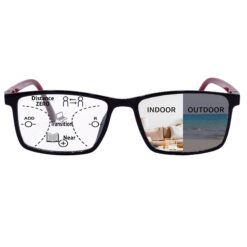
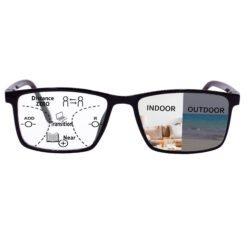
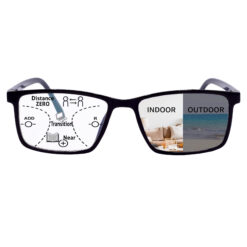
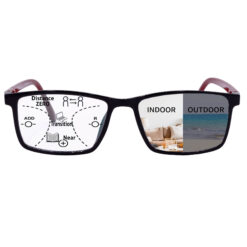
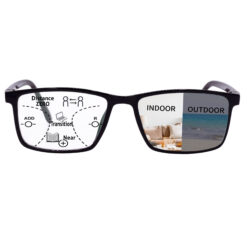
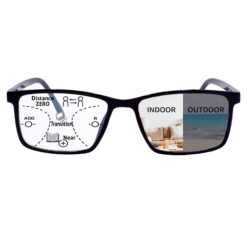
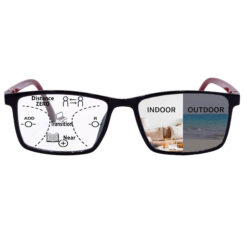
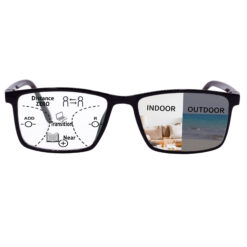
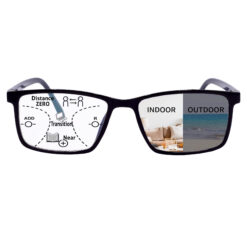
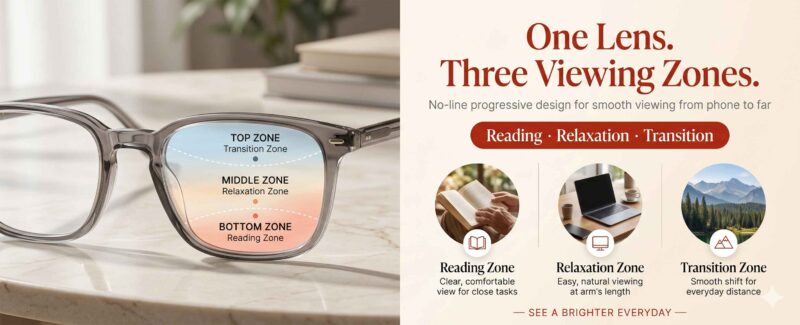
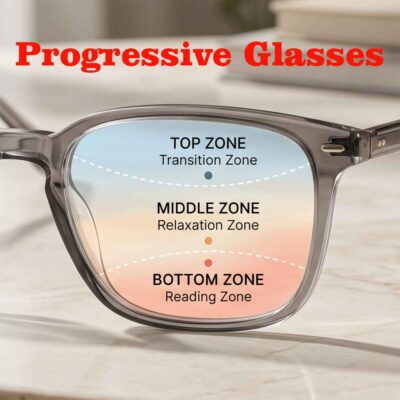
Unlike traditional bifocal lenses that have a harsh, visible dividing line and cause an abrupt “image jump” when your eyes move down, progressive addition lenses (PAL) offer a smooth, invisible gradient of optical power across three vision zones:
-
Top Zone (Distance Vision): Clear 0.00 or prescription distance power for walking, driving, watching television, and recognizing faces across a room.
-
Middle Corridor (Intermediate Vision): Calibrated mid-range power for working on desktop computers, laptops, and car dashboards at arm’s length without tilting your neck backward.
-
Bottom Zone (Near Reading Vision): Full reading addition power (
+1.00,+1.25,+1.50,+1.75,+2.00,+2.25,+2.50, up to+3.00) for reading books, medicine labels, newspapers, and mobile messages comfortably.
When people search for the best progressive lenses price in India, they often find an overwhelming gap between ₹25,000 luxury optical boutique quotes and low-grade plastic readers. We bridge that gap by offering two transparent tiers: ready-to-wear Blue-Cut Anti-Glare Progressive Reading Glasses (starting from ₹699 to ₹1,499) for users with standard near addition needs and zero distance power, alongside custom digital freeform prescription progressive lenses from India’s most trusted optical brands. Every frame in our collection—crafted from lightweight TR90, flexible Ultem, stainless steel, and hand-polished acetate—comes equipped with UV400 protection, scratch-resistant hard coatings, and free shipping across India.
WHY CHOOSE OUR PROGRESSIVE GLASSES & LENSES
-
1 Pair for 3 Viewing Distances: Stop carrying separate reading glasses and computer glasses. Look straight ahead to see across the room, slightly lower for your laptop screen, and down to read your phone.
-
Zero Visible Bifocal Line: Our no-line multifocal lenses look identical to standard single-vision spectacles, giving you a youthful appearance without an age-revealing bifocal cut.
-
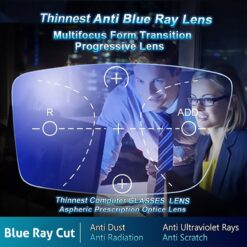
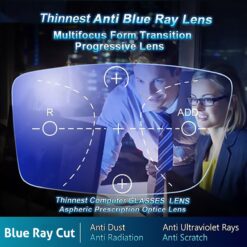
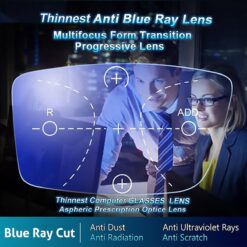
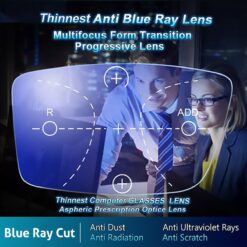
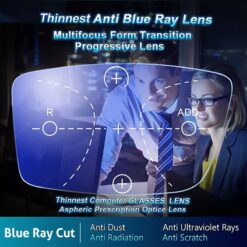
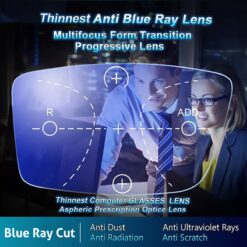
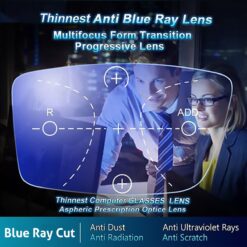
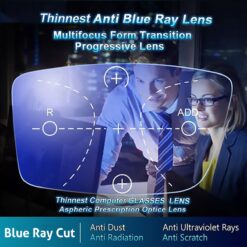
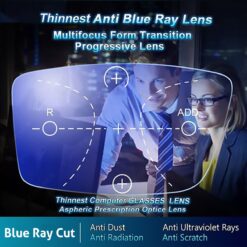
Built-In Blue-Ray Cut & Anti-Glare Protection: Every Hrinkar progressive reading glass comes pre-loaded with a multi-layer anti-reflective (ARC) and blue light blocking filter to prevent digital eye strain, dry eyes, and overhead tube-light glare.
-
Wide-Corridor Easy Adaptation: Engineered with balanced optical corridors that reduce peripheral blur and the “swimming sensation” when turning your head or walking down stairs.
-
Ready-Made & Custom Prescription Options: Buy instant ready-to-wear progressive reading glasses by selecting your ADD power (
+1.00to+3.00), or upload your ophthalmologist prescription (SPH, CYL, AXIS, ADD, and PD) for custom-surfaced lenses. -
Direct Optician Pricing & Free Pan-India Shipping: Backed by Hrinkar Opticals’ decades of dispensing accuracy in Bengaluru, you get optical-store grade lenses at direct online value with ₹0 delivery charges.
BUYING GUIDE: HOW TO CHOOSE PROGRESSIVE LENSES & COMPARE PRICES IN INDIA
1. Progressive Lenses Price in India (2026 Comparison Table)
Before buying multifocal spectacles, compare the exact market prices across ready-made and custom prescription categories in India so you pay only for the technology your eyes require:
| Progressive Lens / Glasses Tier | Best Suited For | Corridor & Coating Technology | Average Price Range in India (₹) |
| Hrinkar Ready-Made Progressive Reading Glasses | Users with clear distance vision (0.00 SPH) who need +1.00 to +3.00 near reading & computer clarity |
Standard & Wide Corridor, Blue-Cut Filter, Anti-Glare (HMC), UV400 + Frame Included | ₹699 – ₹1,499 (Complete Pair) |
| Standard Prescription Progressive Lenses | First-time presbyopia wearers on a practical budget | Conventional Molded Corridor, Hard Multi-Coat (HMC) or Blue Block | ₹1,200 – ₹2,800 / pair |
| Digital Freeform Wide-Corridor Lenses (Nova / Kodak / GKB) | Daily office workers & heavy laptop/smartphone users | Digital Freeform back-surface optimization, 30% wider intermediate zone | ₹2,500 – ₹7,500 / pair |
| Hoya & Nikon Progressive Lenses | Professionals seeking lightweight high-index clarity & reduced peripheral distortion | Balanced View Control, SeeCoat Blue / Recharge anti-fatigue coatings | ₹4,000 – ₹17,000 / pair |
| Essilor Varilux Progressive Lenses (Liberty / Comfort Max / XR) | Wearers with complex prescriptions or astigmatism wanting rapid adaptation | W.A.V.E. 2.0 Technology, Crizal Rock / Prevencia / Sapphire coatings | ₹5,000 – ₹22,000+ / pair |
| Carl Zeiss Progressive Lenses (Light 2 / SmartLife) | Precision optics for constant movement & multi-screen switching | ZEISS Freeform SmartLife technology, DuraVision Platinum / BlueProtect | ₹6,000 – ₹25,000+ / pair |
2. How to Choose Between Ready-Made vs. Custom Prescription Progressives
-
Choose Ready-Made Progressive Reading Glasses if you do not wear distance glasses for driving or watching TV (your distance SPH is
0.00with no high Cylindrical power), and both of your eyes require the same reading addition power (+1.00,+1.25,+1.50,+1.75,+2.00,+2.25,+2.50,+2.75, or+3.00). -
Choose Custom Prescription Progressive Lenses if your prescription includes different Sphere (SPH) powers for each eye, Cylindrical (CYL) and Axis correction for astigmatism, or an asymmetrical Pupillary Distance (PD).
3. Important Features & Lens Materials
-
Corridor Width (Standard vs. Wide vs. Office Corridor): The “corridor” is the vertical channel of clear vision running down the center of the lens. Wider digital corridors minimize the blurry zones on the far left and right edges, allowing faster adaptation.
-
Refractive Index & Lens Materials:
-
1.50 / 1.56 Index CR-39 & NK-55 Resin: High optical clarity (high Abbe value) ideal for powers between
+1.00and+2.00. -
1.59 Polycarbonate / Trivex: Shatter-resistant, impact-proof lenses recommended for rimless frames, half-rim spectacles, and active outdoor users.
-
1.60 / 1.67 / 1.74 High-Index Resin: 25% to 40% thinner and lighter than standard plastic, preventing bulky lens edges on higher prescriptions.
-
-
Minimum Frame Fitting Height: Always select a frame with a vertical lens height of at least 30mm to 34mm (or 14mm–18mm minimum fitting height from pupil center to lower rim) so all three vision zones fit comfortably without cutting off the bottom reading portion.
TYPES OF PROGRESSIVE LENSES & READING GLASSES
1. Blue-Cut Anti-Glare Progressive Reading Glasses
Designed specifically for India’s digital lifestyle, blue-cut progressive reading glasses combine a three-zone multifocal lens with a High-Energy Visible (HEV) blue light filter (blocking harmful 400nm–455nm wavelengths) and a green/blue anti-reflective coating. Whether you are checking WhatsApp messages, working on Excel spreadsheets for six hours, or looking across your office cabin to speak with colleagues, these glasses prevent computer vision syndrome, eye redness, and frontal headaches while keeping nighttime headlight glare to a minimum.
2. Auto-Focus & Ready-to-Wear Multifocal Reading Glasses
Ready-made progressive reading glasses (including flexible auto-focus reading spectacles covering +0.50 to +2.50 diopters) are built for adults with presbyopia who have normal distance vision. The upper portion of the lens contains zero power (Plano 0.00), allowing you to walk around the house, shop in supermarkets, or watch TV without taking your glasses off. The middle and bottom zones gradually increase to your chosen magnification power (+1.00 through +3.00) for effortless reading.
3. Digital Freeform Wide-Corridor Progressive Lenses
Traditional progressive lenses are molded on the front surface, which creates noticeable distortion at the outer edges of the frame. Digital Freeform progressive lenses use computer-controlled diamond-point surfacing on the back of the lens. This places the optical prescription closer to your eye—widening the intermediate computer zone and near reading zone by up to 35% and cutting adaptation time down to just 2 to 5 days.
4. Short-Corridor Progressive Lenses for Compact Frames
If you prefer sleek, narrow rectangular frames or compact metal spectacles (vertical lens height between 26mm and 30mm), standard progressive lenses can cut off the near-reading zone at the bottom. Short-corridor progressive lenses reach full reading addition power within just 13mm to 14mm below your pupil center, giving you crisp close-up reading in modern slim frames.
5. Photochromic (Day-to-Night) Progressive Glasses
Photochromic (light-adaptive or Photogrey/Transitions) progressive lenses remain crystal clear indoors and automatically darken into UV400 sunglasses within seconds of stepping into sunlight. They are ideal for commuters, bikers, car drivers, and field executives across India who want one single pair of spectacles that handles indoor computer work, outdoor sunlight glare, and close-up mobile reading.
TOP BRANDS AVAILABLE
-
Hrinkar (by Optical India): Our flagship in-house eyewear brand engineered specifically for Indian face shapes and tropical weather. Hrinkar progressive reading glasses (including best-selling series like HRPRO11, HRPRO15, and HRPRO16) feature TR90 memory-polymer temples, spring hinges, polycarbonate blue-ray cut lenses, and dual-sided anti-glare coatings at direct-to-consumer prices under ₹1,500.
-
Essilor Varilux (Crizal Coatings): The global pioneer of progressive lenses since 1959. Varilux Liberty 3.0, Varilux Comfort Max, and AI-powered Varilux XR lenses pair with Crizal Rock, Crizal Prevencia (blue-violet filter), and Crizal Sapphire HR coatings to deliver scratch resistance and stability while moving.
-
Carl Zeiss (SmartLife & Light 2): Renowned for German optical engineering, ZEISS Progressive lenses are optimized for modern wearers who constantly shift their gaze between smartphones and the environment, backed by DuraVision Platinum anti-reflective coatings.
-
Hoya & Kodak Lenses: Hoya Amplitude/Dynamic and Kodak Easy Adapt progressive lenses deliver reliable Japanese and American optical geometry at mid-range price points (₹3,000 to ₹8,000), making them popular choices for first-time multifocal wearers.
-
Nova & Indian Freeform Labs: High-value digital progressive lenses offering blue-cut, photochromic, and high-index configurations for budget-conscious prescription buyers.
FEATURES TO CONSIDER
-
Quality: Optician-verified optical centers (OC) and distortion-free CR-39 / polycarbonate lens blanks with zero surface waves.
-
Durability: 6-layer lens protection stack including Dual Hard Coat (scratch resistance), Hydrophobic (water-repellent), Oleophobic (smudge/fingerprint resistant), and Anti-Static dust-repellent layers.
-
Performance: Smooth diopter progression from
+0.00top distance down to+1.00–+3.00near reading power with zero image jump. -
Comfort: Featherlight frame weights (14g to 22g) featuring flexible spring hinges and soft hypoallergenic silicone nose pads that leave no red marks on your nose bridge.
-
Style: Available in Full-Rim Rectangle, Classic Wayfarer, Half-Rim Executive Metal, Rimless Titanium-style, and Women’s Cat-Eye silhouettes in Black, Gunmetal, Tortoise Brown, Blue, and Wine Red.
-
Warranty: 100% power-accuracy guarantee, transit damage protection, and dedicated optical support from our Bengaluru dispensing team.
WHO SHOULD BUY THIS?
-
Corporate Professionals & IT Executives (Age 40+): Switch seamlessly between presenting on a conference room projector, typing on a dual-monitor setup, and reviewing printed reports without touching your frames.
-
Teachers, Professors & Researchers: Read textbook notes on your desk and immediately look up to address students at the back of the classroom with clear distance vision.
-
Bankers, Chartered Accountants & Office Users: Spend 8+ hours analyzing financial figures on monitors and paper ledgers with built-in Blue-Ray Cut protection that stops afternoon eye fatigue.
-
Homemakers & Everyday Users: Cook in the kitchen, read ingredient labels and WhatsApp recipes, watch television, and step out for evening walks wearing a single comfortable pair of spectacles.
-
Style-Conscious Men & Women: Anyone upgrading from old-fashioned lined bifocals or tired of wearing half-moon reading glasses perched on the tip of their nose.
FAQ SECTION (FREQUENTLY ASKED QUESTIONS)
1. What is the average progressive lenses price in India?
The price of progressive lenses in India starts at ₹699 to ₹1,499 for ready-made blue-cut progressive reading glasses (including the frame) on Optical India. For custom prescription progressive lenses, entry-level digital lenses cost between ₹1,200 and ₹3,500 per pair, mid-range wide-corridor lenses (Kodak, Nova, Hoya) range from ₹3,500 to ₹8,500, and premium international brands like Essilor Varilux and Carl Zeiss cost between ₹6,000 and ₹25,000+ per pair depending on refractive index and coatings.
2. How are progressive reading glasses different from bifocal glasses?
Bifocal glasses have only two powers—distance at the top and near reading at the bottom—separated by a visible horizontal line on the lens. They lack an intermediate zone for computer screens and cause an abrupt “image jump” when your eyes cross the line. Progressive glasses feature a seamless, invisible transition across three zones (far, intermediate computer, and near reading) with no visible line on the lens.
3. Can I buy ready-made progressive glasses online without a doctor’s prescription?
Yes, if your distance vision is clear (0.00 power) and you only need magnification for reading and computer work due to age-related presbyopia, you can directly select your near ADD power (+1.00, +1.25, +1.50, +1.75, +2.00, +2.25, +2.50, +2.75, or +3.00) from our ready-made Hrinkar progressive reading glasses collection. If you have distance myopia/hyperopia or cylindrical astigmatism, opt for custom prescription progressive lenses.
4. How long does it take to adjust to progressive lenses for the first time?
Most first-time wearers adapt to wide-corridor progressive glasses within 3 to 10 days. To adapt quickly: wear your new progressive glasses continuously instead of switching back to old spectacles, point your nose toward what you want to see rather than darting your eyes to the far side edges, and tuck your chin slightly down when walking down stairs so you look through the top distance zone.
5. What does ADD power (+1.00 to +3.00) mean on a progressive lens prescription?
“ADD” stands for Reading Addition—the extra magnifying power added to the bottom portion of your lens to help your eyes focus on close-up objects at 35cm to 40cm. Typically, ages 40–44 require +1.00 or +1.25, ages 45–49 require +1.50 or +1.75, ages 50–55 require +2.00 or +2.25, and ages 56+ require +2.50 to +3.00.
6. Which is better for computer work: progressive glasses or single-vision reading glasses?
Progressive glasses (especially Blue-Ray Cut Progressive Glasses) are far superior for computer and office work. Single-vision reading glasses are calibrated only for 35cm close-up reading; wearing them at a desktop monitor (60cm away) forces you to lean forward and strain your neck. Progressive lenses have a dedicated middle corridor calibrated specifically for laptop and desktop distances.
7. Why is there slight blur on the extreme left and right edges of progressive lenses?
Every progressive lens transitions smoothly from distance power at the top to reading power at the bottom without a dividing line. Because of the laws of optical physics, blending multiple powers into a smooth surface creates soft peripheral zones on the lower outer corners. Turning your head slightly to face objects keeps your vision inside the crystal-clear central corridor.
8. Are blue-cut progressive lenses safe to wear all day and while driving at night?
Yes. Our Hrinkar Blue-Cut Anti-Glare Progressive Glasses filter out high-energy blue-violet light from LED screens and fluorescent office lighting while maintaining over 92% visible light transmission. Combined with the anti-reflective coating, they reduce halo glare from oncoming vehicle headlights during night driving and keep your eyes relaxed throughout the day.
9. What frame shape is best for progressive lenses?
Full-rim rectangle, wayfarer, round, and deep cat-eye frames with a vertical lens height of 30mm or more work best for progressive lenses. Avoid ultra-narrow “strip” reading frames, as shallow frames do not leave enough vertical space to fit the distance, intermediate, and near reading zones comfortably.
10. How do I verify my Cylinder (CYL) power before ordering custom progressive spectacles?
Ophthalmologists and optometrists write astigmatism prescriptions in either Plus Cylinder (+CYL) or Minus Cylinder (-CYL) format. Before ordering custom lenses, you can use our free online Glasses Prescription Cylinder Converter on Optical India to transpose your SPH, CYL, and Axis accurately, or WhatsApp a photo of your prescription to our optician support team.